
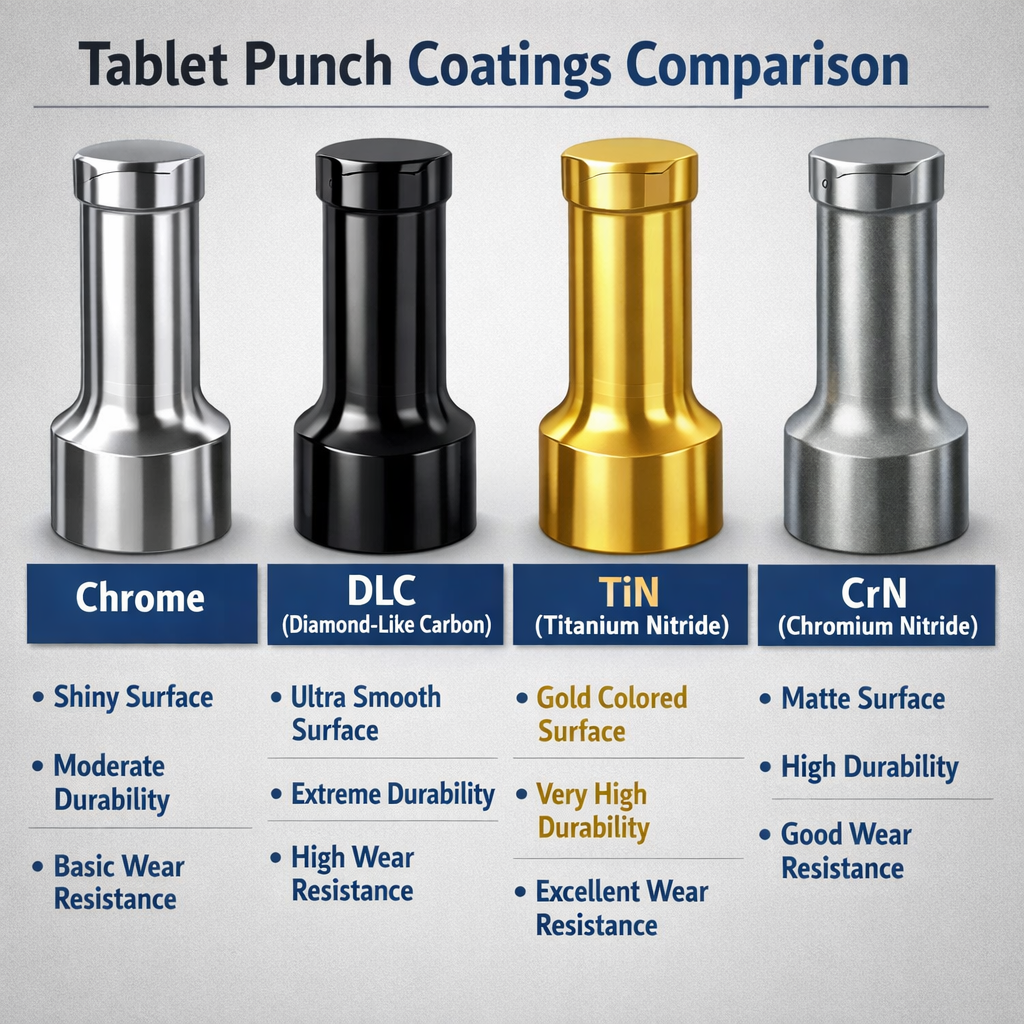
Tablet punch coatings solve specific production problems — sticking, wear, and corrosion. But with multiple coating options available, choosing the right one for your application can be confusing. This guide compares the four most common tablet punch coatings and helps you make a cost-effective decision.
If your current uncoated tooling performs well without sticking or excessive wear, coatings are unnecessary. Coatings add cost — use them to solve specific problems, not as a default specification.
Chrome Plating — The Standard Coating
| Property | Value |
|---|---|
| Hardness | 800—1000 HV |
| Thickness | 5—15 —m |
| Application | Electroplating |
| Color | Bright silver/mirror finish |
Benefits: Reduced sticking, corrosion protection, improved surface finish, low cost, easy to reapply.
Limitations: Moderate wear resistance, can chip or peel if poorly applied, not effective for severely sticky formulations.
Best for: General-purpose corrosion protection, moderate sticking problems, budget-conscious applications, standard pharmaceutical and nutraceutical tooling.
DLC (Diamond-Like Carbon) — Premium Anti-Stick
| Property | Value |
|---|---|
| Hardness | 2000—5000 HV |
| Thickness | 1—3 —m |
| Application | Physical Vapor Deposition (PVD) |
| Color | Dark gray to black |
| Friction coefficient | 0.05—0.15 (extremely low) |
Benefits: Excellent anti-stick properties — the lowest friction coefficient of any common coating. Solves severe sticking problems that chrome cannot. Very hard surface. Chemically inert.
Limitations: Higher cost (3—5x more than chrome). Cannot be reapplied easily. Brittle under extreme impact.
Best for: Severely sticky formulations (herbal extracts, hygroscopic ingredients), ayurvedic and herbal tablet manufacturing, herbal tablet tooling, embossed punches where picking is a problem.
TiN (Titanium Nitride) — Wear Resistance Champion
| Property | Value |
|---|---|
| Hardness | 2000—2500 HV |
| Thickness | 2—5 —m |
| Application | Physical Vapor Deposition (PVD) |
| Color | Gold/yellow |
Benefits: Excellent wear resistance — extends tooling life by 30—50% or more. Hard surface resists abrasion from calcium, iron, and mineral ingredients. Distinctive gold color makes it easy to identify coated tooling.
Limitations: Moderate anti-stick properties — not as effective as DLC for sticking. Higher cost than chrome.
Best for: High-volume production where tooling wear is the primary concern, nutraceutical tablets with mineral ingredients, abrasive formulations containing calcium, iron, or mineral compounds.
CrN (Chromium Nitride) — Dual Protection
| Property | Value |
|---|---|
| Hardness | 1800—2200 HV |
| Thickness | 2—5 —m |
| Application | Physical Vapor Deposition (PVD) |
| Color | Silver-gray |
Benefits: Excellent corrosion resistance — superior to chrome plating. Good wear resistance. Dual protection handles both corrosive and abrasive formulations.
Best for: Corrosive formulations (acidic, effervescent), formulations that are both corrosive and abrasive, environments with high humidity or corrosion risk.
Decision Guide — Which Coating Do You Need?
- Is sticking/picking your main problem? ? DLC (severe sticking) or Chrome (moderate sticking)
- Is rapid wear from abrasive ingredients your main problem? ? TiN
- Is corrosion from acidic/corrosive formulations your main problem? ? CrN (if also abrasive) or Chrome (corrosion only)
- Multiple problems (sticking + wear)? ? DLC. Corrosion + wear? ? CrN
- No specific problems? ? No coating needed — save the cost
Coating Care and Maintenance
- Do not use abrasive cleaning methods — steel wool and abrasive pads damage coatings
- Use soft cloths and mild solvents for cleaning
- Do not attempt to polish coated tips — polishing removes the coating
- Inspect coating integrity — look for peeling, chipping, or wear-through
- Replace when coating is worn through — exposed steel underneath will corrode and stick