
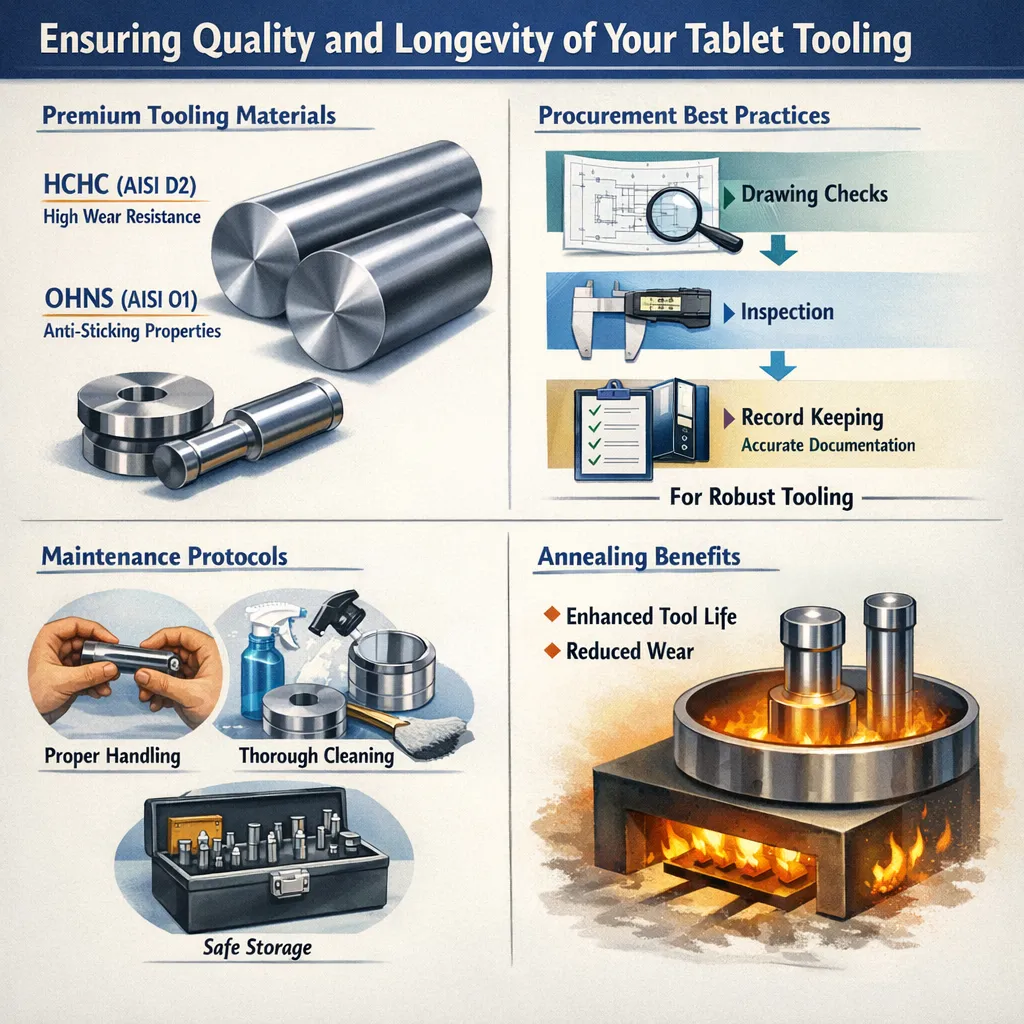
In the highly competitive world of tablet manufacturing, maintaining quality and longevity of your tooling is essential for optimal production efficiency. A proactive approach to material selection, procurement, maintenance, and heat treatment can significantly enhance tooling performance.
The Importance of Material of Construction (MOC)
Material selection is the cornerstone of durable tablet tooling. The material of construction (MOC) used for manufacturing dies and punches directly influences their strength, resistance to sticking, and overall longevity.
| Material | Hardness | Best For |
|---|---|---|
| EMMKAY Special Steel | 55–60 HRC | Most formulations — versatile, economical, recommended default |
| OHNS (AISI O1) | 58–62 HRC | Standard formulations — widely available alternative |
| HCHC (AISI D3) | 62–64 HRC | Abrasive formulations — calcium, iron, mineral excipients |
| S7 | 56–58 HRC | Impact-prone formulations where chipping is an issue |
EMMKAY Special Steel is our recommended default — versatile, economical, and suitable for most formulations. Upgrade to HCHC for highly abrasive formulations or S7 where chipping is a concern.
Best Practices for Tablet Tooling Procurement
Efficient procurement is just as crucial as manufacturing precision in ensuring the longevity of tablet tooling:
- Checking drawings and specifications: Carefully review technical drawings to verify that tooling conforms to specified dimensions and tolerances
- Material approval: Confirm that the materials used have undergone rigorous quality checks
- Inspection: Conduct thorough inspections upon delivery, aligning with predefined quality assurance protocols
- Record-keeping: Maintain comprehensive records of tooling details, which facilitate future audits and maintenance schedules
Maintaining Your Tablet Tooling for Optimal Performance
Maintenance is a critical factor in extending the life of your tablet tooling. See our complete maintenance guide for detailed procedures. Key principles:
- Handling: Use gloves during manipulation to prevent contamination from oils and moisture
- Cleaning: Regular cleaning removes residues and reduces the risk of sticking. Implement procedures that include ultrasonic cleaning where appropriate
- Storage: Store tooling in a clean, dry environment or use protective layers (pharmaceutical-grade oils) to shield against corrosion
- Die taper: An optimal die taper minimizes tablet defects such as capping, ensuring better ejection and tablet integrity
Understanding Annealing and Its Benefits for Tooling Life
Annealing is a vital heat treatment process that can significantly extend the life of your tooling, particularly for fragile punch tips.
- Annealing process: By heating and then gradually cooling the tooling, annealing reduces internal stresses, which minimizes wear during tablet compression
- Improved punch set life: The heat treatment softens brittle areas while retaining necessary strength, leading to reduced chipping and cracking
- Regular inspection: Routine inspections help determine the optimal time to retire and replace punch sets
- Wear and tear reduction: Regular annealing, when paired with correct maintenance practices, can significantly curb the gradual degradation of punch tips and dies
Summary
- Material of construction: Choose high-quality materials like HCHC (AISI D3) or OHNS (AISI O1) to boost durability and reduce sticking
- Procurement best practices: Follow a meticulous process — from drawing checks to record-keeping — to secure robust tooling
- Maintenance protocols: Implement proper handling, cleaning, and storage procedures to sustain tooling performance
- Annealing benefits: Employ heat treatment processes to enhance tool life and mitigate wear issues
For additional insights and guidance on high-performance tablet tooling, contact EMMKAY INDUSTRIES. Our comprehensive approach and advanced tooling solutions empower you to achieve superior efficiency and quality in your tablet manufacturing process.
Related Guides