
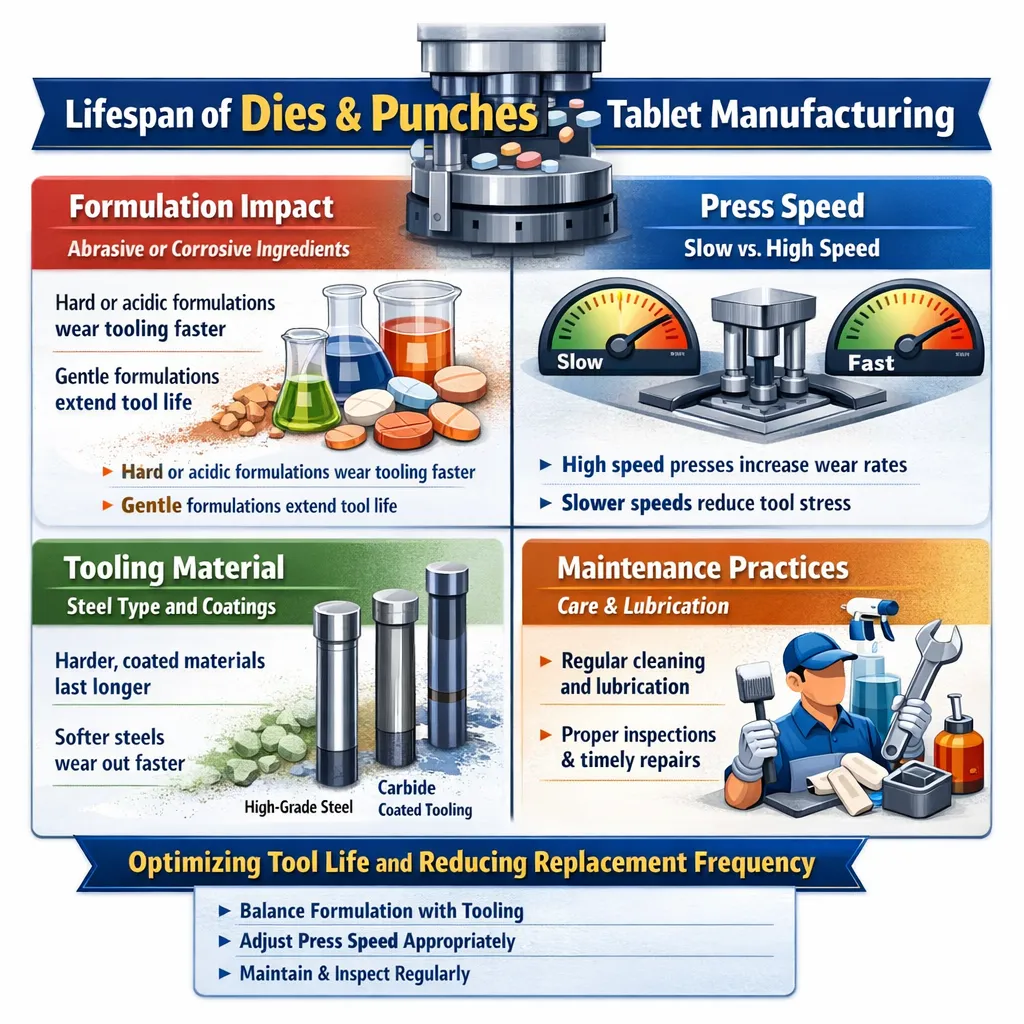
One of the most frequently asked questions in tablet manufacturing is: how long will my dies and punches last before they need replacement? The answer depends on several factors — your formulation, press speed, tooling material, and maintenance practices.
Expected Tooling Lifespan by Material
| Material | Standard Formulation | Abrasive Formulation | With TiN Coating |
|---|---|---|---|
| EMMKAY Special Steel | 5–10 million tablets | 3–6 million tablets | 7–14 million tablets |
| OHNS | 3–5 million tablets | 1–2 million tablets | 4–7 million tablets |
| HCHC / D3 | 5–8 million tablets | 3–5 million tablets | 7–12 million tablets |
| S7 | 3–6 million tablets | 2–4 million tablets | 4–8 million tablets |
With coatings, add 30–50% to these numbers. TiN coating extends life by 30–50% for abrasive formulations. DLC coating extends life by 20–40% and reduces sticking-related wear. Chrome plating extends life by 15–25%.
Important: These are approximate ranges. Your actual results will vary based on the specific factors described below.
Factors That Affect Tooling Life
- Formulation abrasiveness — The most significant factor. Formulations containing calcium carbonate, dicalcium phosphate, iron oxide, or mineral fillers wear tooling much faster than formulations based on lactose, microcrystalline cellulose, or starch.
- Press speed (RPM) — Higher press speed means more compression cycles per hour and faster wear. A press running at 60 RPM wears tooling roughly twice as fast as one running at 30 RPM.
- Compression force — Higher compression force accelerates tip wear and head wear. Formulations requiring high compression force wear tooling faster.
- Tablet size — Larger tablets require more compression force and create more stress on the tooling.
- Maintenance quality — Properly cleaned, lubricated, and stored tooling lasts 2–3x longer than neglected tooling. See our maintenance guide.
- Press condition — A well-maintained press with aligned turret bores and smooth compression rollers extends tooling life. A poorly maintained press causes uneven wear and premature failure.
Signs That Tooling Needs Replacement
Replace immediately: Visible chips or cracks on punch tips, scored or scratched die bores, bent punch barrels, broken or cracked punch heads.
Replace soon: Tablet weight variation exceeding specification, increasing tablet hardness variation, tablet sticking increasing despite proper formulation, embossing becoming shallow or unclear, die bore diameter exceeding tolerance by more than 0.03mm.
Monitor closely: Tablet surface finish deteriorating, compression force increasing for the same tablet hardness, slight increase in tablet weight variation.
How to Extend Tooling Life
- Choose the right material: Match the material to your formulation. Using OHNS for a highly abrasive calcium formulation wastes money — HCHC will last 2–3x longer and cost only 20–30% more per set.
- Use appropriate coatings: TiN for abrasive formulations, DLC for sticky formulations. See our coatings guide.
- Maintain properly: Clean, inspect, lubricate, and store tooling after every production run. This single practice can double tooling life.
- Optimize press settings: Use the minimum compression force needed to achieve target hardness.
- Rotate tooling sets: If you run the same product frequently, rotate between 2–3 tooling sets. This gives each set time to rest and allows for thorough cleaning and inspection.
Lifespan by Steel Grade and Formulation Type
The interaction between steel grade and formulation abrasiveness is the single biggest determinant of tooling lifespan. The table below provides detailed estimates based on real-world production data across thousands of tooling sets.
| Steel Grade | Non-Abrasive | Moderately Abrasive | Highly Abrasive |
|---|---|---|---|
| OHNS | 4–6M tablets | 2–4M tablets | 1–2M tablets |
| HCHC (D3) | 6–10M tablets | 4–7M tablets | 3–5M tablets |
| S7 | 5–8M tablets | 3–5M tablets | 2–4M tablets |
Non-abrasive formulations include paracetamol, ibuprofen, and most herbal extracts. These formulations are gentle on tooling surfaces and allow even basic steel grades like OHNS to achieve respectable lifespans. Moderately abrasive formulations include calcium phosphate and basic mineral blends — these require harder steels like HCHC to maintain cost-effective production runs. Highly abrasive formulations include calcium carbonate, iron oxide, and silica-containing formulations. For these demanding products, premium steel grades and protective coatings are essential to avoid frequent and costly tooling replacements.
When selecting a steel grade, consider the total cost of ownership rather than just the per-set price. HCHC tooling costs approximately 20–30% more than OHNS per set, but it lasts 2–3x longer with abrasive formulations — making it significantly cheaper per million tablets produced.
Signs Your Tooling Needs Replacement
Catching tooling wear early prevents tablet quality issues, press damage, and costly production downtime. Watch for these specific indicators during routine production monitoring and inspection.
- Tablet weight variation exceeding ±3%: This is one of the earliest and most reliable signs of die bore wear. As the die bore enlarges from abrasion, more powder fills the cavity, causing tablets to become heavier and less consistent. If weight variation increases gradually over a production campaign, measure the die bore diameter — if it exceeds the original specification by more than 0.03mm, the die needs replacement.
- Visible wear marks or scoring on punch tips: Inspect punch tips under magnification after each production run. Circular wear rings, scratches, or dull spots on the tip face indicate surface degradation. Worn tips produce tablets with poor surface finish and unclear embossing. Scoring on the tip land area accelerates further wear and can cause sticking.
- Rising ejection forces: If the force required to eject tablets from the die increases over time, the die bore surface has roughened. A rough die bore grips the tablet during ejection, increasing friction and stress on both the tablet and the lower punch. Left unchecked, this leads to tablet capping, lamination, and accelerated lower punch wear.
- Tablet surface defects — sticking, picking, or rough texture: When punch tip surfaces lose their polish, formulation particles adhere to the tip face (sticking) or pull material from the tablet surface (picking). These defects worsen progressively and cannot be resolved by adjusting press parameters — the tooling surface itself must be restored or replaced.
- Punch length shortened by more than 0.05mm: Measure overall punch length periodically using a micrometer or dedicated punch gauge. Compression cycles gradually shorten the punch as the tip and head wear down. A reduction of more than 0.05mm from the original specification affects compression force consistency and tablet weight uniformity across the turret.
Establishing a regular inspection schedule — ideally after every production batch — helps you track wear trends and plan replacements before quality is compromised. Keep a log of die bore measurements and punch lengths for each tooling set to identify when replacement is approaching.
Frequently Asked Questions
Can worn tooling be reconditioned?
Yes, punch tips can be repolished 2–3 times and die bores can be honed to restore surface finish. Reconditioning extends useful life by 20–30% at a fraction of replacement cost — typically 15–25% of the price of a new set. However, reconditioning cannot restore tooling that has been worn beyond dimensional tolerances or has structural damage like chips or cracks. Each reconditioning cycle removes a small amount of material, so there is a limit to how many times tooling can be reconditioned before it falls outside specification. Work with your tooling supplier to determine when reconditioning is viable versus when full replacement is more cost-effective.
Does press speed affect tooling life?
Yes. Higher press speeds (RPM) increase the number of compression cycles per hour, which accelerates wear proportionally. A press running at 80 RPM wears tooling roughly 33% faster than the same press at 60 RPM. This means a tooling set rated for 6 million tablets at 60 RPM may only last 4.5 million tablets at 80 RPM. Balancing press speed with tooling longevity is key to optimizing cost per tablet. In many cases, running at a moderate speed with longer tooling life is more economical than running at maximum speed and replacing tooling more frequently.
Conclusion
Tablet dies and punches typically last 3–10 million tablets depending on material, formulation, and maintenance. The most effective ways to extend tooling life are: choosing the right material for your formulation, using appropriate coatings, and maintaining a consistent cleaning and storage routine.
EMMKAY INDUSTRIES manufactures tablet dies and punches in all material grades and coatings. Contact us to discuss the most cost-effective tooling solution for your specific production requirements.