
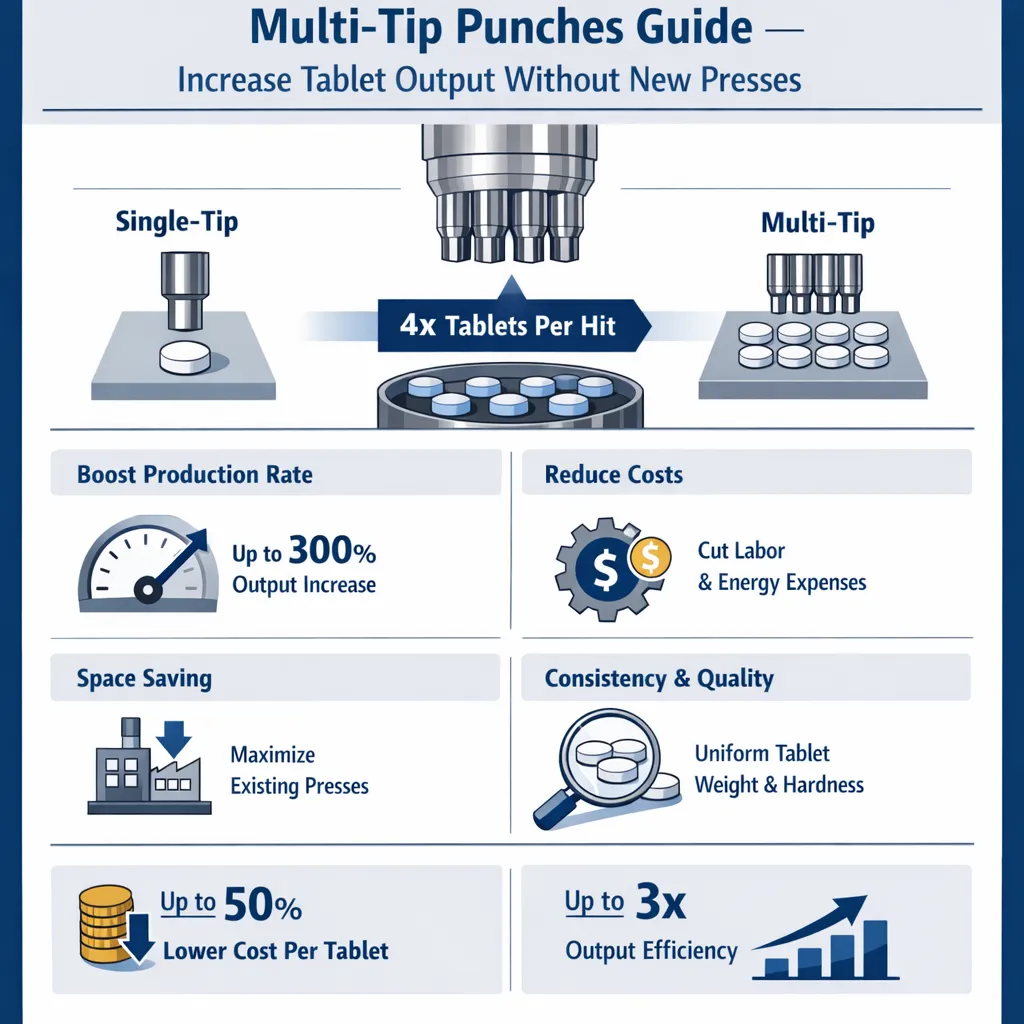
Multi-tip tablet punches are one of the most effective ways to increase tablet production without purchasing additional presses. A single multi-tip punch produces 2, 3, 4, or more tablets per compression cycle — multiplying your output per press revolution by the number of tips.
How Multi-Tip Punches Work
A standard single-tip punch has one tip that enters one die to produce one tablet per compression cycle. A multi-tip punch has multiple tips, each entering its own die, producing multiple tablets simultaneously. The press speed (RPM) stays the same, but each revolution produces 2x, 3x, or 4x more tablets.
Output Example — 45-Station Press at 40 RPM
| Configuration | Tablets/Minute | Tablets/Hour |
|---|---|---|
| Single-tip | 1,800 | 108,000 |
| 2-tip | 3,600 | 216,000 |
| 3-tip | 5,400 | 324,000 |
| 4-tip | 7,200 | 432,000 |
Benefits of Multi-Tip Punches
- Dramatically increased output — 2-tip doubles output, 3-tip triples it
- No additional press required — multi-tip tooling costs a fraction of a new press
- Same floor space — more output from existing equipment
- Lower cost per tablet — labor, electricity, and overhead spread across more tablets
Limitations and Considerations
- Tablet size limitation: Multi-tip configurations only work for smaller tablets. Tablets above 12mm diameter in D tooling are generally limited to single-tip.
- Shape limitations: Round tablets are the easiest and most common multi-tip shape. Non-round shapes are possible but more complex and expensive.
- Higher tooling cost: Multi-tip tooling costs 2–4x more per set due to more complex manufacturing and tighter tolerances.
- Press compatibility: Not all presses can accept multi-tip tooling. Check with your press manufacturer before ordering.
- Formulation sensitivity: Some formulations do not compress well in multi-tip configurations due to uneven die filling.
When Multi-Tip Makes Financial Sense
- You produce more than 1 million tablets per day of a single product
- Your tablets are 9mm or smaller (B tooling) or 13mm or smaller (D tooling)
- Your press is compatible with multi-tip tooling
- Your formulation flows well and compresses consistently
Quality Control for Multi-Tip Production
- Weight uniformity: Check tablet weights from individual tips. Weight variation between tips should be within ±2%.
- Hardness uniformity: Test hardness from tablets produced by each tip. Uneven hardness indicates uneven compression force distribution.
- Dimensional checks: Verify tablet diameter and thickness from each tip — all tips should produce dimensionally identical tablets.
Ordering Multi-Tip Tooling from EMMKAY INDUSTRIES
To order multi-tip tooling, provide: tablet press brand and model, tablet diameter and shape, current tooling standard (D, B, BB, or DB), desired number of tips, formulation details, and quantity of sets.
We manufacture multi-tip tooling in all materials (OHNS, HCHC, S7, EMMKAY Special Steel) and with all coatings (chrome, DLC, TiN, CrN).
Output Calculations: How Much More Can You Produce?
Understanding the output multiplier of multi-tip tooling helps justify the investment. The table below shows how each configuration scales production from a single press station per compression cycle.
| Configuration | Tablets per Station per Cycle | Output Increase | Best For |
|---|---|---|---|
| Single-tip | 1 | Baseline | Standard production |
| 2-tip | 2 | +100% | Round tablets 8–12mm |
| 3-tip | 3 | +200% | Small round tablets 6–9mm |
| 4-tip | 4 | +300% | Mini tablets 4–6mm |
A 45-station D-press running at 60 RPM with single-tip tooling produces approximately 162,000 tablets per hour. The same press with 2-tip tooling produces 324,000 tablets per hour — doubling output without any capital investment in new equipment. Scale that to 3-tip or 4-tip configurations and the numbers become even more compelling: 486,000 and 648,000 tablets per hour respectively from a single press.
For manufacturers running 24-hour production shifts, the difference is staggering. A single press with 4-tip tooling can produce over 15 million tablets per day — output that would otherwise require four separate presses with single-tip tooling. The savings in floor space, labor, electricity, and maintenance are substantial.
Design Considerations for Multi-Tip Tooling
Multi-tip tooling requires tighter manufacturing tolerances than single-tip punches. Every tip must perform identically during compression, which means the design and machining precision are critical to consistent tablet quality.
- Uniform tip spacing: The distance between tips must be precisely equal to ensure each tip receives the same compression force during the cycle. Uneven spacing leads to weight variation between tablets produced by the same punch.
- Tip height consistency: All tips on a single punch must be the same height within ±0.005mm. Even small height differences cause uneven compression — shorter tips produce softer, lighter tablets while taller tips produce harder, heavier ones. This is one of the most critical tolerances in multi-tip manufacturing.
- Die bore clearance: The die bore must be large enough to accommodate all tips with adequate clearance around each one. Insufficient clearance causes tip-to-bore contact, accelerating wear and potentially damaging both the punch and the die. The die design must also ensure uniform powder fill across all cavities.
- Key orientation: Keyed punches are essential for multi-tip configurations. The key prevents the punch from rotating during compression, which would misalign the tips with their corresponding die bores. Rotation during operation can cause catastrophic tooling failure and press damage.
- Tablet shape compatibility: Not all tablet shapes work with multi-tip configurations. Round and simple geometric shapes (such as oval) are best suited because they allow efficient packing of multiple tips within the die bore. Complex shapes like capsule, diamond, or custom logos are difficult or impossible to arrange in multi-tip layouts while maintaining adequate tip spacing and die wall thickness.
At EMMKAY INDUSTRIES, we use CNC-controlled grinding and inspection equipment to hold these tight tolerances consistently across every punch in a set. Each multi-tip punch is individually measured and matched before shipping.
Frequently Asked Questions
What is the maximum number of tips per punch?
The maximum number of tips depends on tablet size and die bore diameter. For D tooling, 2-tip is common for 10–12mm tablets, 3-tip for 7–9mm tablets, and 4–7 tips for very small tablets (4–6mm). The limiting factor is the die bore diameter and the minimum spacing required between tips to ensure uniform compression. Larger die bores (like D tooling's 38.10mm) allow more tips than smaller standards like B or BB tooling.
Do multi-tip punches cost more?
Yes, multi-tip tooling costs 50–100% more per set than single-tip tooling due to the additional machining complexity and tighter tolerances required. However, the cost per tablet produced is significantly lower because output doubles or triples from the same press. For high-volume production runs, multi-tip tooling typically pays for itself within weeks of operation. The real savings come from reduced labor, electricity, and overhead costs spread across a much larger number of tablets.
Conclusion
Multi-tip tablet punches are a proven way to multiply production output from existing presses. For small tablets in high-volume production, they offer the best return on investment of any single tooling upgrade. The key to success with multi-tip tooling is selecting the right configuration for your tablet size, ensuring your press is compatible, and working with a manufacturer that can hold the tight tolerances required for consistent multi-tip performance.
When evaluating multi-tip tooling, consider the total production economics — not just the tooling cost. A 2-tip set that costs 75% more than single-tip but doubles your output reduces your cost per tablet by nearly half when you factor in labor, electricity, and machine time. For manufacturers producing tens of millions of tablets per month, this translates to significant savings.
EMMKAY INDUSTRIES has been manufacturing multi-tip tooling since 1983. We produce 2-tip, 3-tip, and higher configurations in all material grades and with all standard coatings. Contact us to discuss whether multi-tip punches are right for your production line and to receive a detailed output calculation for your specific press and tablet configuration.
Multi-Tip Shape Pages