
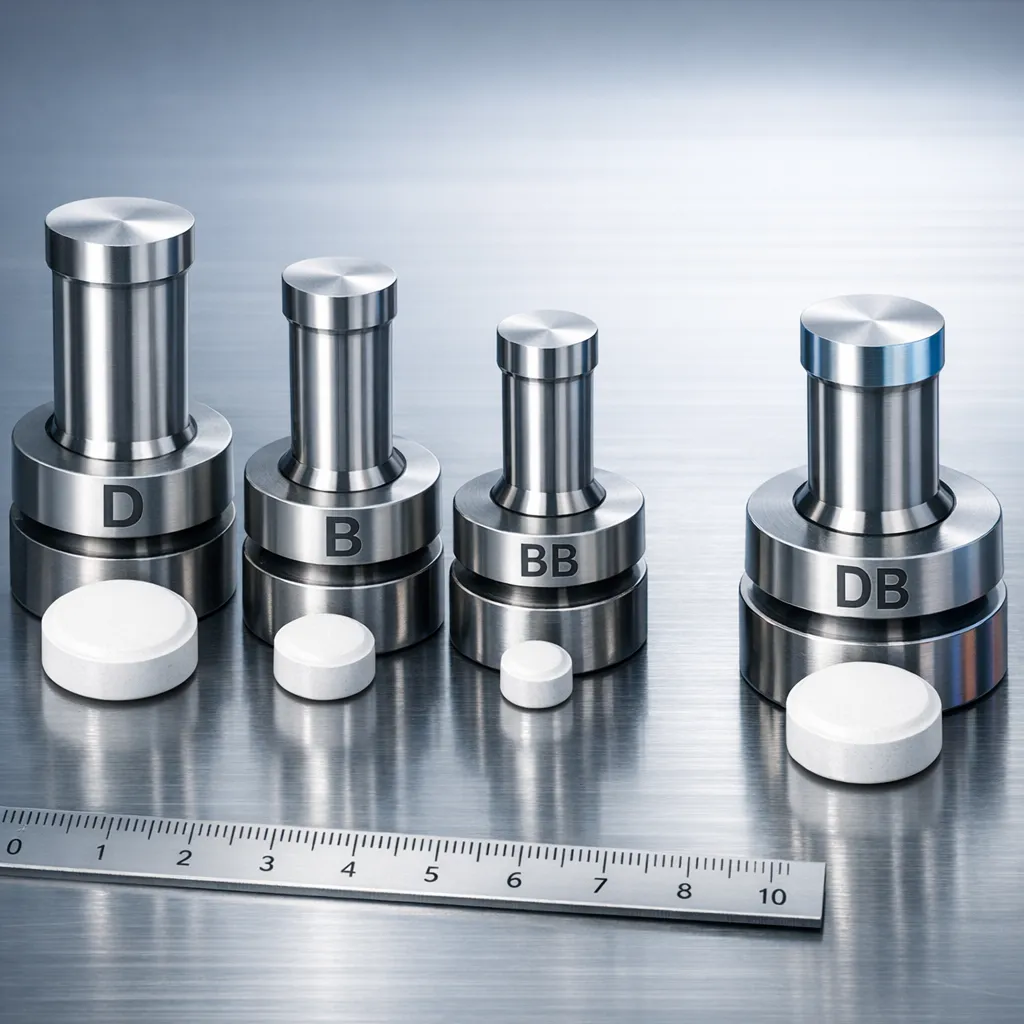
One of the most common questions in tablet manufacturing is: what is the difference between D tooling, B tooling, and BB tooling? The answer determines which tooling fits your press, what tablet sizes you can produce, and how efficiently your production line runs.
The Four Tooling Standards at a Glance
| Standard | Die OD | Max Tablet | Punch Barrel | Best For |
|---|---|---|---|---|
| D Tooling | 38.10mm (1.5") | 25mm | 25.4mm | Standard to large tablets — most common worldwide |
| B Tooling | 30.16mm (1.1875") | 18.5mm | 19.0mm | Large tablets, veterinary, effervescent |
| BB Tooling | 24mm (0.945") | 18.5mm | 19.0mm | Compact presses, more stations per turret |
| DB Tooling | 30.16mm (B die) | 25mm | 25.4mm (D punch) | Large tablets on B tooling presses |
D Tooling — The Industry Standard
D tooling is the most widely used tablet tooling standard in the world. The majority of rotary tablet presses in pharmaceutical, nutraceutical, and confectionery manufacturing use D tooling.
- Die OD: 38.10mm (1.500 inches)
- Maximum tablet diameter: 25.0mm
- Compatible with most standard rotary tablet presses
- Widest range of shapes, configurations, and accessories
Best for: Standard pharmaceutical tablets (6–25mm), most nutraceutical tablets, confectionery, effervescent tablets (typically 20–25mm).
Limitation: Cannot produce tablets larger than 25mm.
B Tooling — For Large Tablets
B tooling uses a 30.16mm die OD with a 19.0mm punch barrel. It is designed for tablets up to 18.5mm diameter.
Best for: Large nutraceutical tablets and supplements (13–18.5mm), veterinary boluses, large confectionery tablets and mints, effervescent tablets.
Limitations: Fewer stations per turret than BB tooling. Not efficient for tablets under 13mm. Larger die pockets mean higher material cost per set.
BB Tooling — Compact and Efficient
BB tooling uses a 24mm die OD with a 19.0mm punch barrel. It is designed for compact presses and supports tablets up to 18.5mm diameter.
Best for: Small to medium tablets on compact presses, maximizing stations per turret on BB-compatible presses.
Limitations: Not all presses accept BB tooling — check compatibility. Maximum tablet diameter is 18.5mm.
DB Tooling — The Versatile Option
DB tooling uses B-size dies (30.16mm OD) with D-size punch barrels (25.4mm). This allows you to produce larger tablets (up to 25mm) on a press designed for B tooling.
Best for: Producing large tablets on a B tooling press, facilities that need up to 25mm tablets on a B-press.
Output Comparison
The number of stations per turret directly affects production output. Since die size determines how many stations fit, the hierarchy is:
- BB tooling (24mm die) = MOST stations (smallest dies)
- B tooling (30.16mm die) = MEDIUM stations
- D tooling (38.10mm die) = FEWEST stations (largest dies)
However, D tooling is still the most common standard because it can handle the full tablet size range (3–25mm) while B and BB are limited to 18.5mm. D tooling is the ONLY standard that can produce tablets from 18.5–25mm.
When to Choose D Tooling
D tooling is the right choice in these specific scenarios:
- Tablets larger than 13mm diameter — B tooling's maximum practical size for round tablets is around 13mm. For anything larger, D tooling gives you the die bore space you need.
- High-dose formulations requiring large tablet volume — Formulations like metformin 500mg or calcium 1250mg need large tablets to hold the required dose. D tooling supports tablets up to 25mm diameter.
- Tablets requiring deep concave profiles — D tooling's larger tip area provides more room for deep concavity, reducing the risk of punch tip chipping during compression.
- When your press is a D-type press — Most rotary tablet presses worldwide, including the majority of Cadmach and ACG presses in India, are D-type presses. If your press has 38.10mm turret bores, you need D tooling.
- When maximum compression force is needed — D tooling handles higher compression forces than B or BB tooling because of its larger barrel diameter (25.4mm vs 19.0mm). This matters for hard tablets and high-density formulations.
When to Choose B Tooling
B tooling is the better option in these situations:
- Tablets 13mm or smaller — If all your tablets are 13mm or under, B tooling works well and the smaller die OD (30.16mm) allows more stations per turret.
- When you need more stations per turret — B tooling's smaller die size means more stations fit on the turret, which directly increases tablets per hour. For high-volume production of small tablets, this output advantage is significant.
- Small-batch production where changeover speed matters — B tooling sets are lighter and faster to handle during changeovers. For contract manufacturers running multiple products per day, this saves time.
- When your press is a B-type or BB-type press — Smaller presses from manufacturers like Rimek and Karnavati often use B or BB tooling. Check your turret bore size — if it is 30.16mm, you need B tooling.
Can You Switch Between D and B Tooling?
No, you cannot use D tooling in a B press or vice versa. The turret bore sizes are different — D tooling requires 38.10mm bores while B tooling requires 30.16mm bores. The punches also have different barrel diameters (25.4mm for D, 19.0mm for B), so they physically will not fit.
The one exception is DB tooling. DB tooling uses B-size dies (30.16mm OD) with D-size punch barrels (25.4mm). This hybrid standard allows you to produce D-sized tablets (up to 25mm) on a B tooling press. It is a practical solution if you have a B press but occasionally need larger tablets.
Switching from one tooling standard to another requires either changing the entire turret (expensive and not always possible) or buying a different press. This is why choosing the right tooling standard at the time of press purchase is critical. If you are unsure which standard your press uses, contact EMMKAY INDUSTRIES with your press brand and model number — we can confirm the correct tooling standard.
Frequently Asked Questions
Which tooling standard is more common in India?
D tooling is the most common in India, used by the majority of Cadmach and ACG presses. These two brands dominate the Indian pharmaceutical machinery market, and both primarily manufacture D-type rotary tablet presses. B and BB tooling are used in smaller Rimek and Karnavati presses, which are popular for lower-volume production and R&D labs.
Is D tooling more expensive than B tooling?
D tooling costs slightly more per set because it uses more raw material — the barrel is larger (25.4mm vs 19.0mm) and the die is bigger (38.10mm vs 30.16mm OD). The price difference is typically 10-15%. However, D tooling produces larger tablets, so the cost per tablet can actually be lower for high-dose formulations. For standard-size tablets, the cost difference is minimal and should not drive your tooling standard decision — press compatibility should.
Conclusion
D tooling is the LARGEST standard (38.10mm die OD) and the right choice for most tablet manufacturing — it handles tablets from 3mm up to 25mm. B tooling is MEDIUM-sized (30.16mm die OD) for tablets up to 18.5mm. BB tooling is the SMALLEST standard (24mm die OD) for compact presses. DB tooling provides flexibility on B tooling presses when you need tablets up to 25mm.
Remember: Only D tooling can produce tablets from 18.5mm to 25mm diameter. If you are unsure which standard your press uses, contact EMMKAY INDUSTRIES with your press brand and model number.
Tooling Standard Pages